
🇩🇴 How to Import from Panama to the Dominican Republic?

Dominican citizens and businesses looking to purchase tax-free goods from the Free Zone have three primary methods available. The easiest option is purchasing online through Bridgemarkets Marketplace, which enables you to consolidate merchandise across multiple suppliers while managing comprehensive shipping logistics to the Dominican Republic. The second alternative is buying online directly from Panamanian distributors; to do this, consult the Official Directory of Companies in the Colon Free Zone. Suppliers are organized by industry category, simplifying your sourcing process. Representatives will provide detailed wholesale procurement guidance and help you select qualified logistics operators for ocean, overland, or air cargo.

The third alternative is traveling to Panama to inspect inventory directly across the showrooms in Colón. Prior research on official directories is highly recommended to identify the stores carrying your target products. Considering that the Colón Free Trade Zone is the largest in the Americas and second largest globally, covering 1,064.58 hectares, structured advance planning is essential to maximize your time on-site. Once orders are placed, the buyer coordinates cargo transport and customs clearance with an authorized logistics provider.
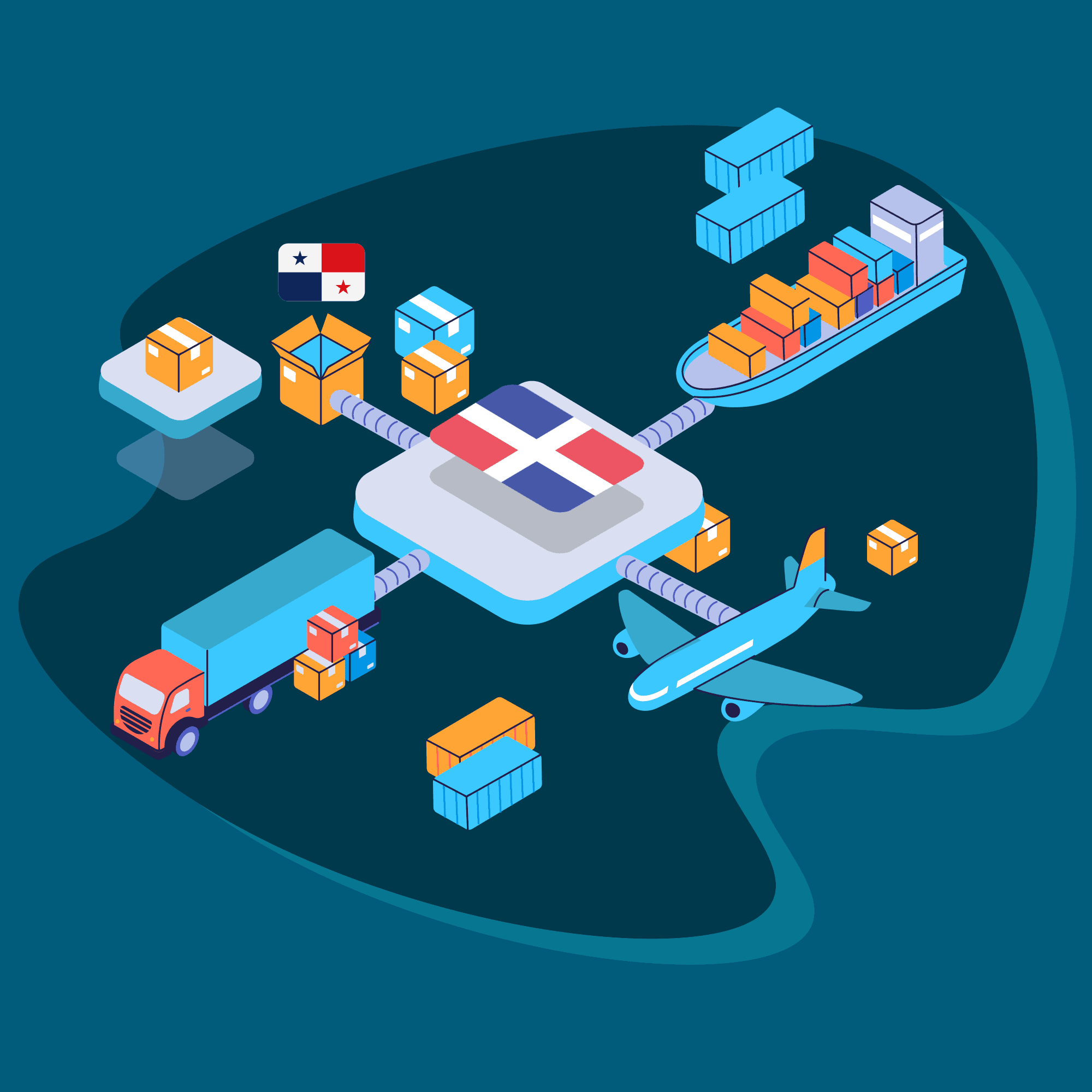
Importar desde la Zona Libre de Colón en Panamá hasta República Dominicana

📦 What Products Can Be Imported?

Today, Panama has emerged as a premier wholesale trading hub in Latin America, celebrated for its expansive catalog of merchandise and globally recognized brands. What sets Panama apart as a sourcing origin is the operational speed and efficiency of its cargo processing and dispatch, consistently outperforming distant manufacturing hubs like China. This efficiency is critical: while overseas manufacturing may offer low upfront unit prices, Panama guarantees immediate product availability, reliable inventory, and verified quality control, avoiding common procurement hurdles in distant markets.

Bilateral trade between the Dominican Republic and Panama has expanded significantly over recent years. According to UN COMTRADE data, the Dominican Republic imports upwards of $562M USD in goods originating or distributed through Panama annually.

Agriculture

Manufacturing Articles

Musical Instruments

Jewelry & Watches

Medicine

General Merchandise

Office & School

Industrial Products

Security

📄 What Are the Requirements to Import Goods into the Dominican Republic?

Before beginning the import process into the Dominican Republic, you must determine whether documentation will be submitted to Dominican Customs (Dirección General de Aduanas – DGA) as a Corporate Entity, Individual, or Commercial Partnership. If you do not have direct access to the SIGA platform, you can engage an authorized Customs Broker (Agencia de Aduanas) certified by the DGA to act as your legal representative before customs authorities. The initial step involves registering across relevant government agencies that authorize commercial import entries.

  • Registration in the Integrated Customs Management System (SIGA)
  • National Taxpayer Registry (RNC – Registro Nacional de Contribuyentes)
  • Importer Registration with the General Directorate of Customs (DGA)
  • Mercantile Registry Certificate (Certificado de Registro Mercantil)
  • Tax Identification Number (NIF)
  • Digital Authentication Certificate (Digital Signature)
  • Single Customs Declaration (DUA – Declaración Única Aduanera)
  • Customs Bond covering 100% of CIF value (where required)
  • Import License or prior ministerial permit
  • Commercial Invoice
  • Tax Assessment & Liquidation Report
  • Bill of Lading (B/L) or Air Waybill (AWB)
  • Packing List
  • Certificate of Origin
  • Specific Additional Documentation depending on product category:
    • Letter of Commitment (Carta de Compromiso)
    • Tax Clearance Certificate from DGII
    • Manufacturer Quality & Inspection Reports (depending on product)
    • Serial Number List for Imported Units
    • Photographs of Barcode Markings
    • Compliant Product Labeling in Spanish

🚢 How Much Does Freight Cost from Panama to the Dominican Republic?

Container specifications and destination port selection directly determine overall freight costs. Loading terminals in Panama include the Port of Cristóbal, Manzanillo International Terminal (MIT), and Colon Container Terminal (CCT), routing to Dominican terminals such as Santo Domingo, DP World Caucedo, or Río Haina. Selecting the arrival terminal closest to your distribution network optimizes freight efficiency. Average ocean transit time spans between 2 and 4 sailing days.

A 20-foot container (20ft) is suited for small to medium-volume loads. Estimated ocean freight from Panama to the Dominican Republic starts at approximately $970, offering an accessible solution for trial shipments and growing retail lines. For high-volume inventory, a 40-foot container (40ft) starting around $1,290 provides a substantially lower cost per cubic meter, maximizing commercial margins.

To ensure optimal routing and competitive tariffs, we recommend requesting itemized quotes from multiple international freight forwarders.

📁 What Are the Import Tariffs and Taxes in the Dominican Republic?

When importing from Panama, landed cost calculations must incorporate customs duties alongside national taxes. The Dominican customs tariff schedule features seven base duty rates (0%, 3%, 8%, 14%, 20%, 25%, and 40%). Sensitive agricultural commodities, adjusted under WTO technical rectification quotas, incur higher protective tariff bands.

Preferential tariff treatments under bilateral trade frameworks and statutory exemptions for international bodies and diplomatic missions are integrated into the national tax regime. Merchandise imported under temporary admission or inward processing regimes is exempt from import duties.

Customs duties are calculated on the CIF (Cost, Insurance, and Freight) value of the import, converted into Dominican Pesos (DOP) at the official customs exchange rate. In addition to import tariffs (Arancel), consignments are subject to ITBIS (Value Added Tax – 18%), Selective Consumption Tax (ISC, where applicable), and customs clearance handling charges. Duty exemptions and preference verifications are administered through the DGA and the General Directorate of Fiscal Policy (DGPLT).

Establishing an accurate landed cost model—covering supplier invoice value, international transport, cargo insurance, customs brokerage, and local port terminal handling—is essential to protect commercial profit margins before cargo dispatch.

🛬 Which Commercial Airports Receive Imports in the Dominican Republic?

The Dominican Republic operates several international commercial airports that provide vital connectivity for air passenger and cargo transportation. Key air freight gateways include:

  • Punta Cana International Airport (PUJ / MDPC): Primary airport in Punta Cana with dedicated cargo handling facilities.
  • Las Américas International Airport (SDQ / MDSD): Located in Santo Domingo, this is the country’s primary commercial air cargo hub, processing the vast majority of international freight and customs clearances.
  • Cibao International Airport (STI / MDST): Primary airport serving Santiago and the northern industrial Cibao region.
  • Gregorio Luperón International Airport (POP / MDPP): International airport serving Puerto Plata and the north coast.
  • La Romana International Airport (LRM / MDLR): Key airport serving the southeastern region and commercial free zones.

⚓ What Are the Ocean Transit Times from Panama to the Dominican Republic?

Maritime transit typically starts from just 2 days depending on the arrival terminal, supported by regular weekly container vessel rotations. Key seaports include:

  • Port of Santo Domingo: Located in the capital, handling general cargo, breakbulk, and agricultural commodities with modernized terminal access.
  • DP World Caucedo: One of the most modern marine terminals in the Caribbean, operating as a primary logistics hub and free trade zone handling approximately 66% of Dominican containerized TEUs. Direct ocean transit time from Panama starts at approximately 2 days.
  • Port of Río Haina: Situated in the southern industrial zone near Santo Domingo, handling high-volume general and containerized cargo with transit times from approximately 4 days.
  • Port of Puerto Plata: Vital commercial seaport serving northern regional trade and container shipments.
  • Port of Barahona: Features specialized operating terminals handling dry bulk, petroleum derivatives, and mineral commodities.

For terminal handling fees, demurrage rates, and vessel schedules, consult the Dominican Port Authority (APORDOM) and your ocean carrier.

📄 Consulate of the Dominican Republic in Panama

The Consular Section of the Embassy of the Dominican Republic is located at Calle Aquilino de la Guardia, Edificio Galerías Balboa, 3rd Floor, Office 56, Panama City. Contact via telephone at (+507) 6952-4279 / (+507) 264-8630 / (+507) 265-4364.

🏨 Where to Stay When Visiting Panama for Wholesale Sourcing?

Booking early ensures optimal commercial lodging rates. Below are established hotel choices favored by business buyers visiting the Colon Free Zone. These accommodations offer strategic proximity and direct taxi or shuttle transport into the commercial complex.

You can also check accommodation availability in Panama City and near the Free Zone for your intended dates. Through our arrangement with booking.com, visitors receive special corporate discounts for business stays.

⚓ What Types of Ocean Shipping Containers Are Available?

Dedicated logistics services designed for cargo transit from Panama to the Dominican Republic offer tailored equipment based on shipment volume:

FULL CONTAINER LOAD (FCL) FROM PANAMA TO THE DOMINICAN REPUBLIC:

Explore Full Container Load (FCL) options to the Dominican Republic available in standard 20ft and 40ft units. For consignments requiring specialized equipment—such as open-top, flat-rack, or temperature-controlled refrigerated containers (reefers)—specialized freight divisions in the Colon Free Zone arrange optimal equipment tailored to your cargo.

LESS THAN CONTAINER LOAD (LCL / CONSOLIDATION) FROM PANAMA TO THE DOMINICAN REPUBLIC:

If your shipment volume does not require a full container, shared ocean consolidation (LCL) provides weekly cargo space. Freight pricing is assessed according to cargo volume (CBM), with weight-based tariffs applied should the weight exceed statutory cubic meter thresholds.