
🇨🇱How to import from Panama to Chile?

For Chileans looking to buy tax-free products in the Panama Free Zone, there are three main alternatives. The first consists of shopping online using Bridgemarkets Marketplace, a platform that facilitates the grouping of products from multiple suppliers and handles logistics to Chile. As a second option, there is the possibility of buying directly from Panamanian stores online, checking the Official Directory of Companies in the Free Zone to find wholesalers classified by product type, allowing you to obtain specific information about wholesale purchases and shipping options, both maritime and air.

The third option for Chilean consumers is to travel directly to Panama to explore the showrooms in Colon. It is recommended to do prior research on DIZOLICOL to identify the stores that sell the items of interest. Due to the large extent of the Colon Free Zone, which is the largest in America and the second in the world with 1,064.58 hectares, detailed trip planning is vital to make the most of the available time. Upon completing the purchases, you must coordinate with a logistics company for the shipment of the products to Chile.
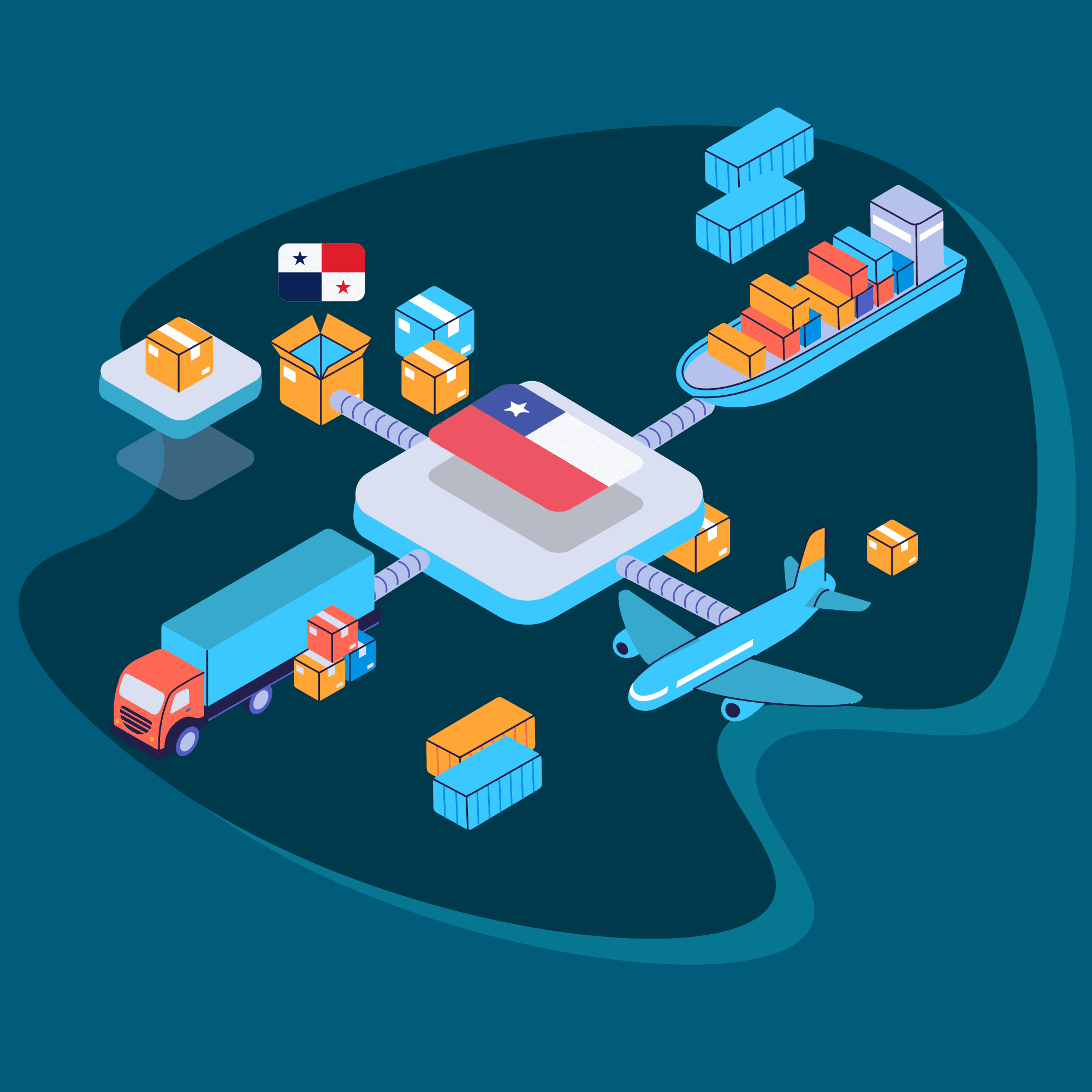
Importar desde la Zona Libre de Colón en Panamá hasta Chile

📦What products can be imported from Panama to Chile?

Currently, Panama has consolidated itself as the wholesale commercial center of Latin America, standing out for the wide variety of products it offers, including major world-renowned brands. Furthermore, one of the strong points of importing from Panama is the dispatch time of goods, which is usually much more agile than that of other markets, such as the Asian giant. This is a relevant aspect to consider, since, although China can offer competitive prices, Panama guarantees the availability of high-quality products, which is not always easy to find amidst the extensive Chinese supply.

In general, it is possible to import a wide range of products to Chile, provided that the necessary requirements and procedures are met. However, it is essential to keep in mind that some items may be subject to import restrictions or prohibitions due to safety, public health, environmental, or commercial and political considerations. For this reason, it is advisable to consult with the Superintendency of Industry and Commerce of Chile and have the support of a customs agent to ensure that the products you wish to import are allowed and comply with all legal requirements. With proper planning and compliance with regulations, you can take advantage of Panama’s wholesale market and satisfy the demand in Chile with quality products and logistical efficiency.

Now, if there are products that Chile can import, Chilean businessmen are the ones who buy the most in the free zone:

  • ✅ Textiles and Clothing
  • ✅ Technology
  • ✅ Beauty and Perfumes
  • ✅ Medicine
  • ✅ Footwear
  • ✅ Furniture & Outdoors
  • ✅ Cars & Motorcycles
  • ✅ Jewelry

Agriculture

Manufacturing Articles

Musical Instruments

Jewelry & Watches

Medicine

General Merchandise

Office & School

Industrial Products

Security

📄What are the requirements to import from Panama to Chile?

Depending on the value of the merchandise, the import process is governed by two different systems:

1– For non-commercial merchandise that travelers wish to carry with them under Heading 009 (which allows tourists to temporarily bring in personal effects), the value limit is up to US$ 3,000 FOB. For commercial merchandise, the limit is up to US$ 1,000 invoiced. The import procedure can be carried out in a simplified manner, and the importer can do it personally before the corresponding Customs office.

To carry out the procedure, the importer must present the following documents:

  • Original bill of lading or equivalent document, depending on the means of transport used.
  • Commercial invoice detailing the merchandise and its value.
  • In cases where the procedure is carried out by a third party, a power of attorney from the owner or consignee for the specific clearance will be required.
  • In certain cases, approvals or additional certifications may be necessary, as appropriate.

With these documents, the importer will be able to complete the import process more quickly and easily before the respective Customs office.

2– If the value of the merchandise exceeds US$1,000 FOB value, the importer is obliged to hire a customs agent.

In case the customs clearance of the merchandise must be carried out by this professional, the importer must provide the agent with the necessary documents to prepare the Entry Declaration, which can be submitted to the Customs Service via the internet.

Regarding the required documents, it is important to mention that there are some that are mandatory for all commercial imports, while others are only requested on certain occasions.

The mandatory documents for all commercial imports are the following:

  • Original bill of lading, waybill or air waybill, demonstrating the ownership of the merchandise by the consignee.
  • Original commercial invoice, detailing the merchandise subject to sale and its values.
  • Sworn Declaration of the importer regarding the price of the merchandise, a form provided by the customs agent.
  • Mandate constituted by the mere endorsement of the original bill of lading.

Regarding the documents that are required only for certain import operations, the following are included:

  • Certificate of Origin, in case the import benefits from any tariff preference due to a Commercial Agreement.
  • Packing list, when applicable, especially for merchandise packaged in containers.
  • Insurance certificate, if the premium value is not specified on the commercial invoice.
  • Expense Note, when these are not included in the commercial invoice.
  • Permits, visas, certifications, or approvals, as necessary.

These documents are essential to comply with customs requirements and facilitate the import of commercial merchandise. By having a customs agent, the process will be carried out appropriately and in accordance with current regulations.

🚢How much does shipping from Panama to Chile cost?

✅ If you need to know how much it costs to send a package to Chile from Panama, the first thing is to have information about the merchandise you want to send on hand, such as destination, weight, and measurements of the package. Then you should contact the air or maritime transport companies in Panama and perform a search in the official directory of the Colon Free Zone. Sending your products from Panama guarantees better delivery times than shipping from the United States of America or China.

Generally, air shipments ✈ when buying in Panama and sending to Chile have a daily frequency, and maritime shipments ⛴ have a weekly frequency. The first thing you should do is ask the transport company if they have containers available to move your merchandise to its destination.

📦What is the difference with importing products from China?

The main difference between bringing merchandise from China or from Panama to Chile is the distance between the countries. Importing from China will require a greater amount of time to transport the products due to the distance and the supplier; it can last in transit from 30 to 60 days to deliver to your Pacific Ports; while importing from Panama will be faster due to proximity. Furthermore, buying in China can involve a higher cost due to shipping expenses and potential tariffs, whereas stocking your business from Panama can be more economical due to proximity and the Free Trade Agreement between Chile and Panama.

💻 Is it safe to buy online from Chile?

Yes, it is safe to buy in Panama if you are Chilean. To do so, we recommend contacting the Free Zone companies directly. You can find the contact details for each one at directoriozolicol.com. Many of these companies have websites or social networks through which you can communicate with them and clarify any doubts you may have.

It is important to note that Panama and Chile have good political and commercial relations, which facilitates the exchange of different items through import and export.

Once you have found where to buy, you must look for a company that ships to Chile from Panama. If you choose maritime shipping, it is advisable to check if they have containers available to move your merchandise and thus avoid inconveniences with waiting times. Keep in mind that upon arriving in Chile, the merchandise may take several days to be processed before you can pick it up.

On the other hand, if you prefer air shipping, it will arrive faster, but you must still wait for the National Customs Directorate of the Republic of Chile to process the merchandise. Shipping prices from Panama to Chile will depend on the products you buy and the type of transportation you choose. It is recommended that you consult with the logistics company to obtain precise information about costs and estimated times.

What taxes must be paid to import into Chile?

The taxes that must be paid when importing from Panama to Chile are directly related to the CIF value (Cost, Insurance, and Freight) plus a 6% ad valorem duty. The components to calculate the values to pay are:

  • CIF value of the merchandise.
  • Insurance premium.
  • International freight value.
  • Ad valorem duty of 6%.
  • VAT of 19%.

It is important to note that these are not the only expenses to consider; in certain cases, it may be necessary to pay special taxes, which are also calculated based on the CIF value of the import. Therefore, it is essential to have a clear understanding of the costs involved and comply with customs requirements when importing to Chile.

⚓What are the sailing times from Panama to Chile?

Chile has several commercial ports on its Pacific coast, which are important for international trade and the country’s economy. Generally, the transit time between Panama and Chile ranges from 6 to 12 days of sailing depending on the destination port, in addition to having weekly departure frequencies. Some of the most important ports are:

  • Port of Valparaíso: Located in the city of Valparaíso, it is one of the most important ports in Chile and stands out for its infrastructure and capacity to receive large vessels. The transit time to the port is a minimum of 9 days.
  • Port of San Antonio: Situated in the city of San Antonio, it is another relevant port for Chilean foreign trade and has modern facilities. The transit time to the port is a minimum of 9 days.
  • Port of Antofagasta: Located in the city of Antofagasta, in northern Chile, it is a strategic port for receiving merchandise in the area. The transit time to the port is a minimum of 8 days.
  • Port of Iquique: Found in the city of Iquique, also in northern Chile, it is an important port for international trade. The transit time to the port is a minimum of 8 days.
  • Port of Arica: Situated in the city of Arica, in the extreme north of Chile, it is another relevant port for import operations. The transit time to the port is a minimum of 6 days.

To obtain detailed information on all ports in Chile, I would recommend consulting with the National Maritime Authority of Chile.

📄Where is the Consulate of Chile located?

Currently, the Republic of Chile has a consular office in the Torres de Las Américas Building, Floor 7, Tower B, Punta Pacífica, San Francisco, Panama City, and which you can contact by phone at +507-203-1890, its Emergency number +507-6678-3655, or through its email ciudaddepanama@consulado.gob.cl

🏨Where to stay if I travel from Chile?

If you book in advance you can save a lot of money; below we show you the hotel options chosen by the merchants who visit us in the Free Zone. Keep in mind that they are close by and you have the option to take a van or taxi that will take you inside it.

We also show you the options for hotels near the Free Zone and if you like you can consult the tentative dates for your trip. We have an agreement with the hotel search portal booking.com to offer our visitors the best deals on accommodation.

📄What is the Free Trade Agreement between Panama and Chile?

The Free Trade Agreement (FTA) between Chile and Panama was signed on June 27, 2006, and entered into force on March 7, 2008. This historic agreement marked the first that Panama established with a South American country. Its content covers various chapters that include topics related to goods, rules of origin, customs procedures, sanitary and phytosanitary measures, technical barriers to trade, and trade defense, among other aspects.

As a result of this agreement, Panama granted Chile an immediate tariff reduction on 64.5% of total Chilean exports to its market. By 2017, approximately 93% of the tariff lines were completely duty-free to allow the entry of Chilean products into the Panamanian market.

On the other hand, Chile opened its market, reducing tariffs for 92.5% of exports originating from Panama. The tariff reduction for 5.8% of these exports was negotiated over a period of 5 years, while the remaining 1.3% was agreed upon for a 10-year period. Currently, around 100% of the negotiated products enter the Chilean market with a 0% tariff. By the year 2022, it is expected that 97% of the products will also enter the Panamanian market with zero tariffs.

Regarding investments, both countries signed an Agreement for the Reciprocal Promotion and Protection of Investments in December 1996, an agreement that was ratified with the signing of the FTA.

In addition to the signing of the FTA, an Environmental Cooperation Agreement and a Labor Cooperation Agreement were established in parallel, demonstrating the commitment of both nations to address relevant issues in these areas. The treaty has contributed to strengthening commercial and economic ties between Chile and Panama, benefiting both countries in their commercial exchanges and investments.